
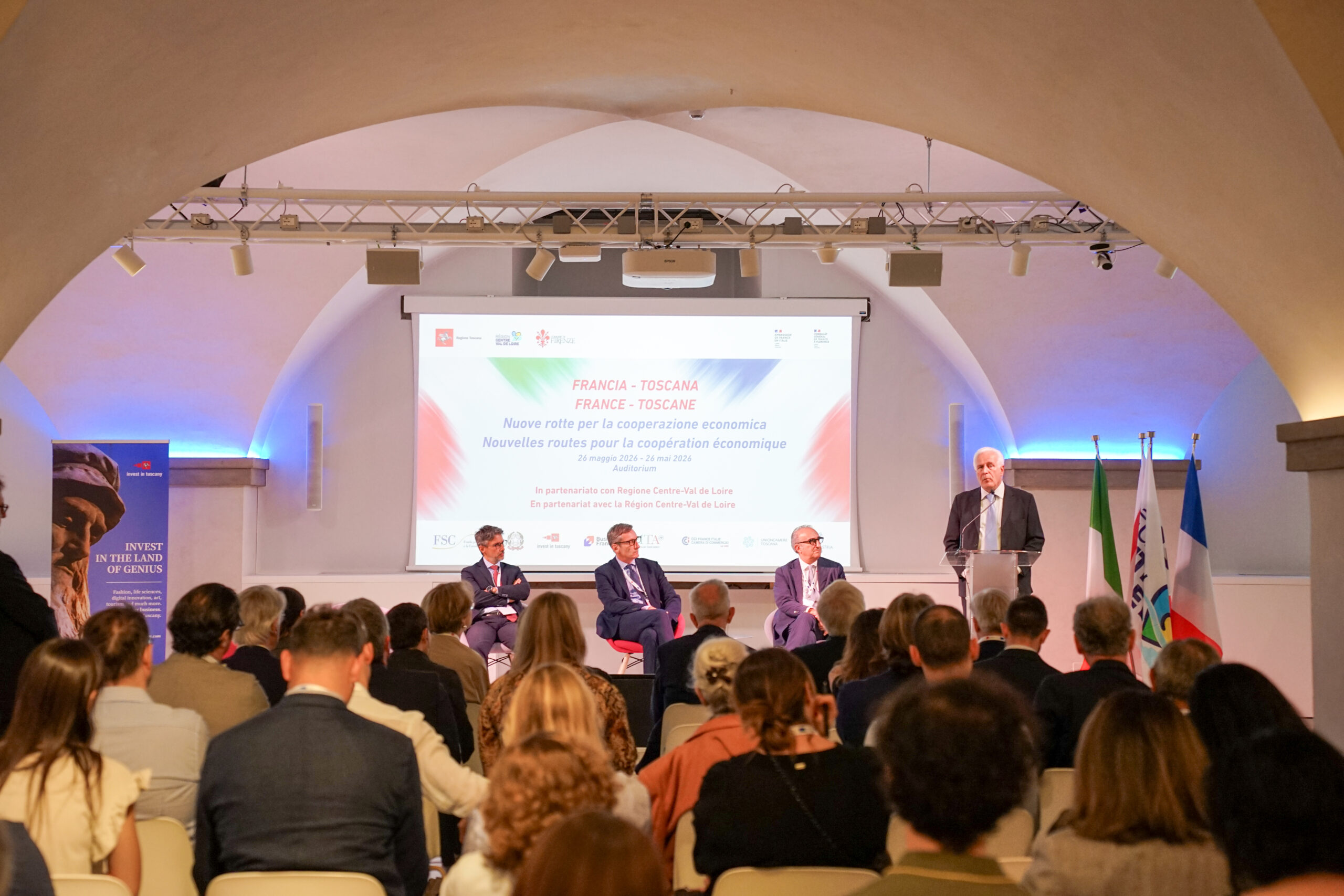
On 26 May 2026, Florence hosted the France-Tuscany Forum: New Routes for Economic Cooperation, a high-level event organised by the Tuscany Region and the French Embassy in Italy, in partnership with the City of Florence and the French Consulate General in Florence. The forum brought together institutional representatives on a national an regional levels (Business France, ITA, CCI France Italie, Unioncamere Toscana e Confindustria Toscana), business leaders, and sector experts from both sides of the Alps to strengthen economic ties and identify concrete opportunities for collaboration.
A Partnership Rooted in History, Oriented Toward the Future
The relationship between Tuscany and France is one of the most deeply rooted in European history — from the Medici family’s influence on French culture to the Lorraine grand dukes who shaped Tuscany’s modern identity. The forum built on this foundation to address the challenges and opportunities of today: ecological transition, industrial competitiveness, technological sovereignty, and social cohesion.
This year’s edition reserved a special role for the Région Centre-Val de Loire, with which Tuscany has maintained a privileged partnership since 2018. Born around culture and tourism, the protocol has since expanded to encompass economic development, sustainable agriculture, training, and research.
A Day of Dialogue and Operational Exchange
The morning sessions provided a comprehensive overview of the bilateral economic framework, presenting data on investment flows, internationalisation instruments, and the tools available to businesses looking to grow across borders. The figures underline the strength of this relationship: France is the leading source of foreign-controlled companies in Tuscany, with 114 firms and over 21,000 employees, while Tuscan exports to France amount to €7 billion annually. Tuscany itself ranks among Europe’s most attractive mid-sized regions, positioned 4th by the Financial Times for investment appeal.
The afternoon featured three parallel working sessions, each dedicated to a strategic sector: life sciences and pharmaceuticals, sustainable tourism and UNESCO heritage, and the luxury and fashion supply chain. Bringing together voices from both regions, the sessions focused on identifying complementarities and translating them into actionable cooperation pathways. Key findings were presented in a closing plenary session.
Building Complementarity into Action
Regional Councillor for Economy Leonardo Marras closed the forum with a message that encapsulated the day’s spirit: Tuscany’s productive transformation cannot be faced alone. The differences between Tuscany and France are not obstacles — they are the foundation of a complementarity that is ready to be organised. Tuscan SMEs can serve as niche suppliers of excellence for major French groups and clusters, while French innovation ecosystems can offer Tuscany’s businesses access to networks, capital, and structured research and development they could not reach independently.
The France-Tuscany Forum confirmed that regional cooperation, when built on shared strategic priorities and mutual knowledge, is one of the most effective levers for sustainable economic growth in Europe.