
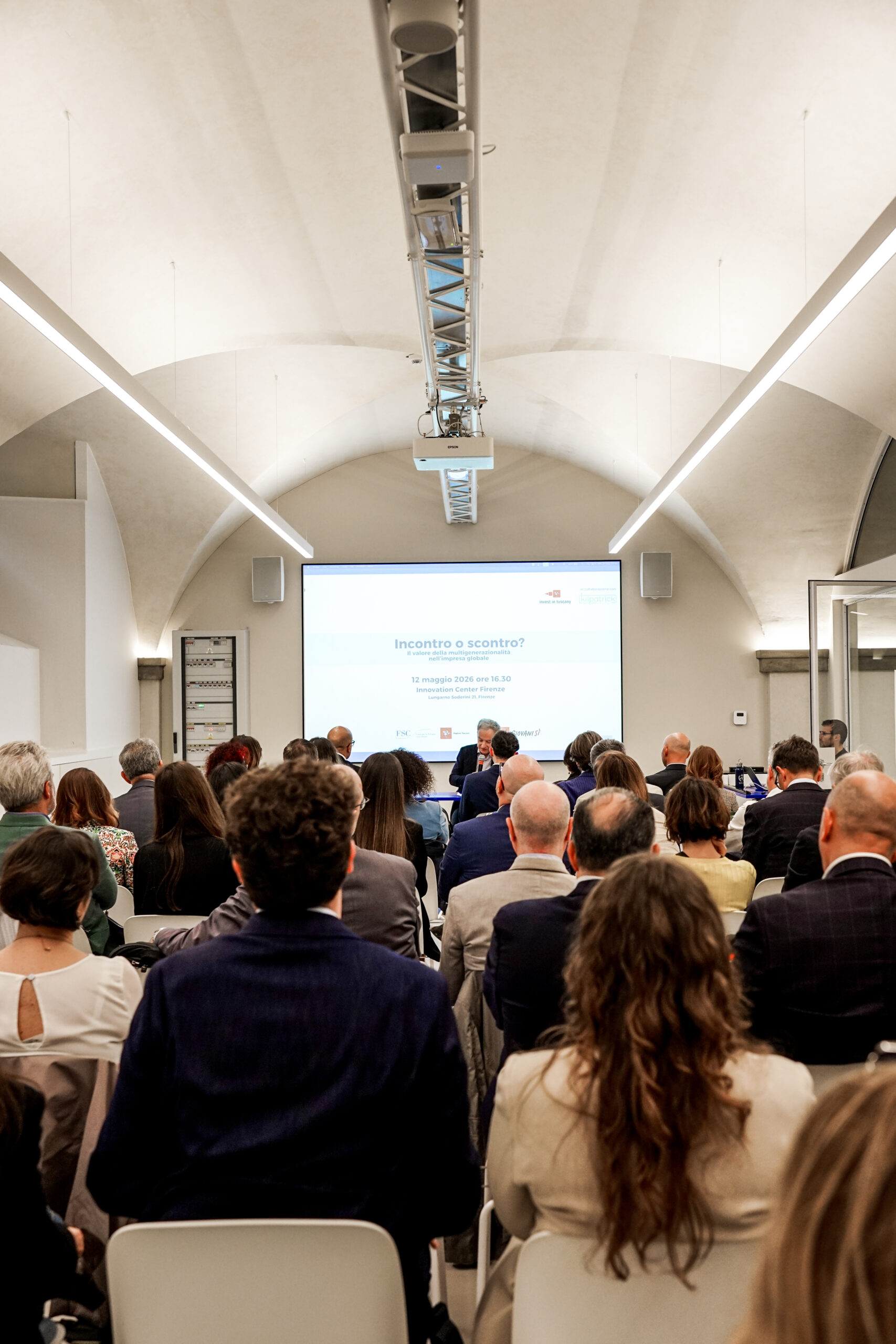
Tuscany is emerging as a leading regional laboratory for multigenerational talent management, with companies that embrace generational diversity proving more innovative, more resilient, and better positioned to compete globally. This was the central message of “Incontro o scontro? Il valore della multigenerazionalità nell’impresa globale”, a study afternoon hosted by Invest in Tuscany on 12 May 2026 at the Innovation Center in Florence.
Organised in collaboration with Kilpatrick Executive — a human resources consultancy and member of the Invest in Tuscany Network — and Giovanisì, the Tuscany Region’s programme for youth autonomy, the event brought together institutions, young professionals, and multinational companies operating in the region. The shared objective was to provide concrete tools and reliable data to help businesses transform the generational gap into a productive and strategic asset.
The afternoon drew on an international survey on Gen Z and the world of work conducted by Kilpatrick Executive between July and October 2025. The findings reveal a sector in cultural transition: 80% of companies surveyed consider retaining Gen Z employees more challenging than retaining other generations, with the most significant divergences emerging around work approach, leadership style, and communication. Gen Z brings a distinctly open orientation toward flexibility and wellbeing, while previous generations tend to favour more structured models. Organisations best positioned to succeed, the research suggests, are those capable of integrating these emerging values into more agile, participative, and transparent leadership models — yet many companies have yet to translate this awareness into structured strategies.
Bernard Dika, Under-Secretary to the Presidency of the Tuscany Region and coordinator of Giovanisì, addressed the event with a clear institutional message: generational diversity is not a challenge to be managed, but a resource to be capitalised. Tuscany already hosts numerous examples of companies leading in multigenerational talent management — from multinational corporations with regional headquarters to family enterprises navigating leadership transition — making the region an authentic avant-garde laboratory for the broader trends reshaping European business culture. Also representing the Tuscany Region were Paolo Ernesto Tedeschi, Director of Territorial Competitiveness and Managing Authority, and Filippo Giabbani, Head of International Activities and Investment Attraction — whose participation underscores the direct link between talent strategy and investment promotion.
For companies evaluating Tuscany as a destination for operations or expansion, the region’s systemic approach to workforce development offers a measurable advantage. Programmes such as Giovanisì support youth employment at a structural level, while initiatives like this study session reflect a business environment that treats talent management as a driver of competitiveness, not merely an internal HR function. A workforce that is young, integrated, and supported by regional infrastructure translates directly into operational capacity and long-term sustainability — key factors for any investor with a horizon beyond the short term.