
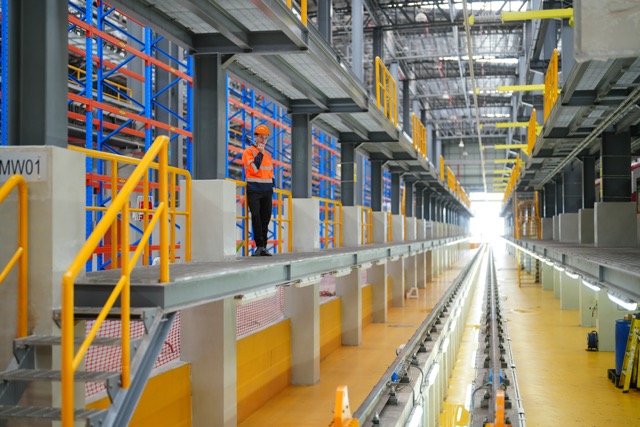
The Celli family of Lucca has inaugurated a new production hub in Porcari, in the province of Lucca, backed by an investment of about €15 million. The project marks a clear strategic step for the family, which is now focusing on industrial automation, integrated logistics and renewable energy.
From paper machinery to automation
In April 2025 the family sold its business producing machines for toilet paper and paper towels to the Austrian group Andritz. Since then, it has operated through the holding company Italia Technology Alliance (ITA), whose activities span three main areas:
- Industrial automation and electrification
- EPC (engineering, procurement and construction) for solar parks
- Integrated logistics, including laser-guided shuttles and carts and robots
A 9,000 m² hub built in two years
The new site covers 9,000 square metres, of which 7,700 m² are dedicated to production and 1,200 m² to offices. Construction took two years, and the facility was inaugurated just days before the news was reported.
The hub brings together two controlled companies, Sadas and Smartlogistix, which together generate about €50 million in revenue and employ roughly 100 people:
- Sadas is the larger of the two, with almost 80 employees, and was previously based in Lucca.
- Smartlogistix, a spin-off of Celli NonWovens, delivers intralogistics solutions (hardware, software and automation for warehouse flows) to the pharmaceutical, corrugated cardboard and food and beverage sectors.
Smartlogistix is also growing through acquisitions. Its most recent is Smartlog, a company from Treviso that builds automated warehouses and robotic systems.
Designed with sustainability in mind
The facility was conceived to reduce consumption and environmental impact. It includes solar panels, thermal and acoustic insulation and a rainwater collection system, along with green areas and common spaces designed to encourage collaboration between business units.
A long-term commitment to the territory
According to shareholders Mauro and Alessandro Celli, the investment reflects the ongoing commitment of ITA and the family to the region. They plan to keep investing in infrastructure, technology and people to support future industrial growth.
The project is a good example of how established Tuscan manufacturing know-how can evolve towards advanced automation and logistics technologies, keeping skills, jobs and value creation in the region.
Text created with AI assistance