
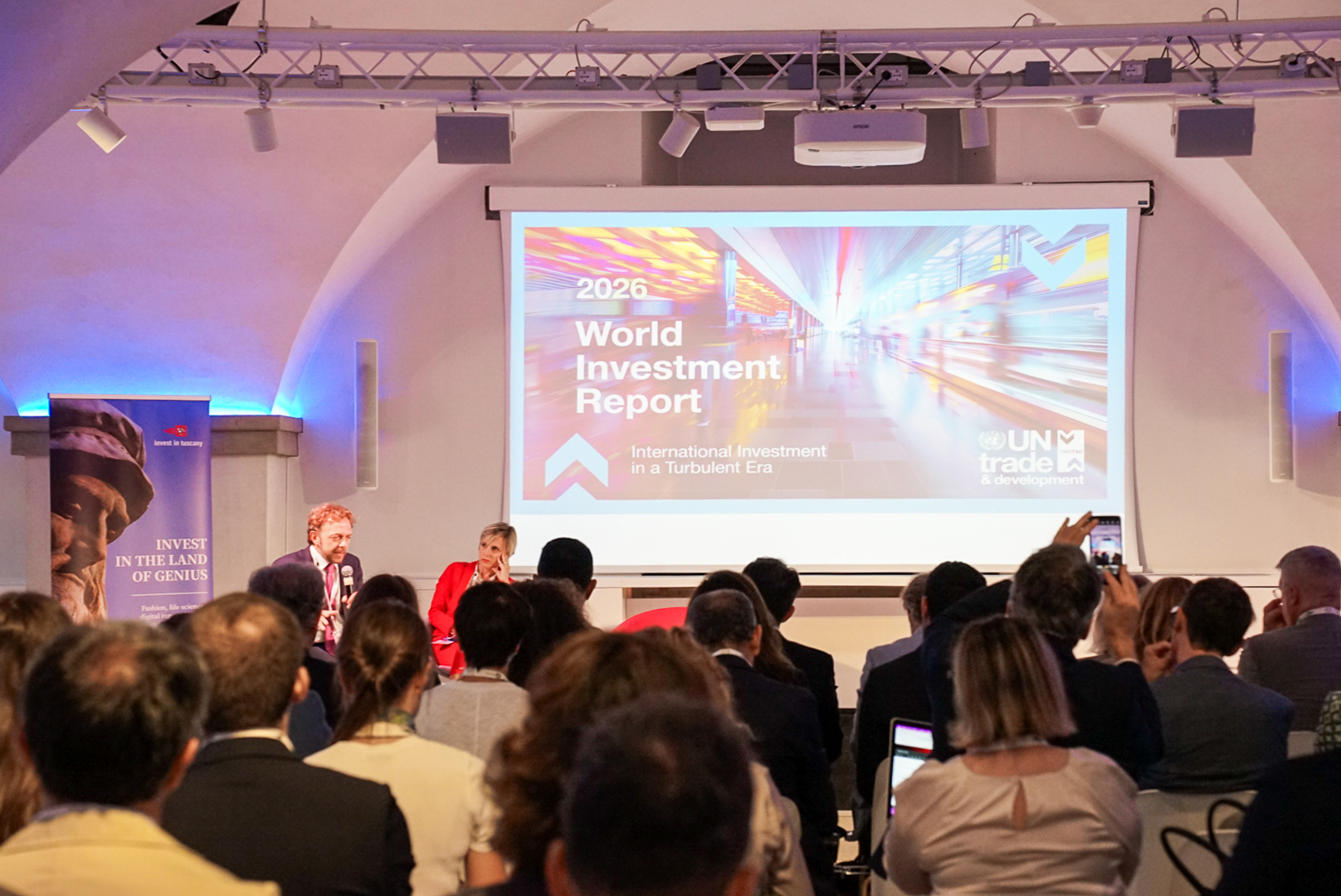
Tuscany was the only Italian region to host the presentation of the World Investment Report 2026, UNCTAD‘s annual study on global Foreign Direct Investment (FDI). The event took place on 17 September at the Innovation Center in Florence, organized by the Invest in Tuscany office of the Region’s Territorial Competitiveness Directorate. It marked an official step toward Selecting Italy, the national forum promoted by the Conference of Regions and Autonomous Provinces on strategies for attracting foreign capital.
The presentation offered an opportunity to examine the shifting dynamics of international investment, highlighting how supply chain security, the ecological transition, and advanced technological skills have become decisive factors in the location choices of foreign-controlled companies. The report was presented by Bruno Casella, senior economist at UNCTAD, with contributions from Regione Toscana’s Paolo Tedeschi, Director of the Territorial Competitiveness Directorate, and Filippo Giabbani of the Invest in Tuscany office, alongside representatives from business and academia. Remote interventions were also delivered by Deputy Minister Valentini (MIMIT) and Dr. Lobasso (MAECI).
Globally, artificial intelligence, geopolitics and the energy transition are redrawing the map of capital flows, with strategic sectors — AI and data centers, semiconductors, green technologies, critical minerals and advanced technologies such as biotech and defence — now absorbing a far greater share of greenfield investment than just a few years ago. Casella noted that while traditional value chains such as non-electric automotive, electronics and textiles are under pressure, investment in strategic sectors is growing sharply, with AI and data-center infrastructure alone accounting for roughly a third of global foreign investment.
For Italy, semiconductors, data centers and renewables have been the main drivers of growth, and the priority now is to strengthen retention and aftercare to keep these investments anchored and open the door to further growth. This is precisely the approach Tuscany has embraced: Invest in Tuscany’s Filippo Giabbani stressed that, given the challenges posed by protectionist policies abroad, the most urgent task is to care closely for companies already established in the region, encouraging their growth rather than focusing solely on attracting new investors.
Speaking remotely, Deputy Minister for Enterprises and Made in Italy Valentino Valentini argued that no single national measure is enough on its own — it’s the coordination between national, regional and local institutions that gives investors the flexibility they’re really looking for, since international investors pay close attention to how quickly a territory responds and whether there is friction between different levels of government. He added that governments today can no longer simply wait for investment to arrive: they actively seek it out, select it and shape its conditions — which means that for a manufacturing economy like Italy’s, and for a region like Tuscany, having a solid production system is not enough; that system also needs to be effectively communicated and positioned in the right sectors.
The Florence event also underscored the balance Tuscany must strike going forward: building the skills the most advanced sectors require, while continuing to attract and retain the multinational companies that help address the region’s ongoing loss of talent. In this context, Tuscany’s model — proactive attraction, stable aftercare, and a network of expertise spanning universities, research centers and production districts — was recognized as an example of how a region can integrate foreign investment into its own value chain, strengthening its position in the national debate on economic attractiveness.
President Eugenio Giani reaffirmed this commitment: “It is a source of pride for Tuscany to host the only Italian stop of the World Investment Report 2026 presentation. UNCTAD’s choice confirms the work carried out in recent years to build an ecosystem capable of attracting, supporting, and growing quality investment. Tuscany demonstrates that it is a reliable partner, with strong expertise, mature industrial districts, and institutions that ensure continuity.”
Text created with AI assistance