
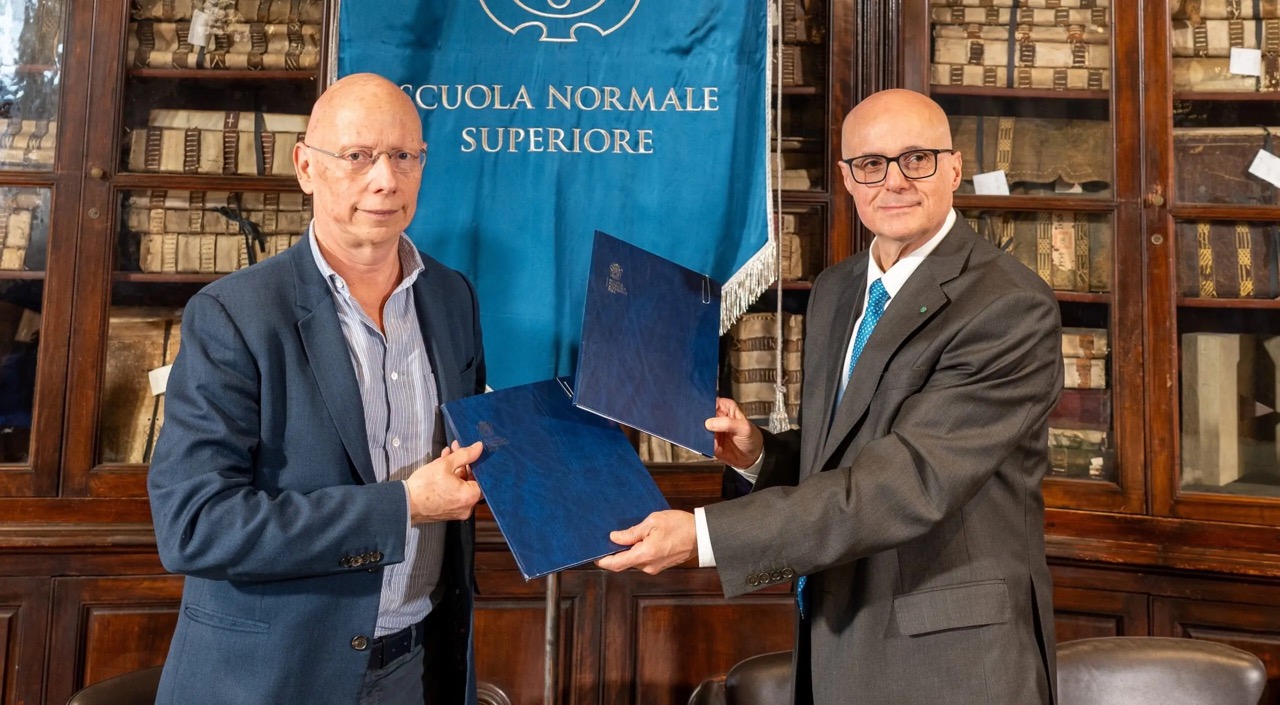
Tuscany continues to cement its standing as one of Europe’s foremost destinations for academic excellence. The Scuola Normale Superiore of Pisa and Paris’s École Normale Supérieure (ENS) have signed a renewed and expanded cooperation agreement, valid until 31 August 2031, deepening a collaboration that stretches back to the two institutions’ shared Napoleonic origins and their common commitment to merit-based selection and collegiate academic life.
The agreement was formally signed at the Palazzo della Carovana in Pisa by Director Alessandro Schiesaro and ENS Director Frédéric Worms, marking a new chapter in the long-standing Franco-Italian academic partnership.
A European framework for research and talent
For the first time, the agreement formally acknowledges both institutions’ membership of EELISA (European Engineering Learning Innovation and Science Alliance), a European University Alliance that significantly broadens the scope for joint initiatives and the capacity to attract talent and funding across the continent. The two schools will now actively co-propose international projects on shared research priorities, leveraging the strength of their respective identities within a common European framework.
The renewed agreement consolidates Pisa’s position as a European hub for academic excellence, with direct implications for research competitiveness, qualified mobility, and the capacity to build cross-border institutional networks — all key factors for investors and businesses seeking talent-rich environments.
Concrete collaboration: research, mobility, and doctoral programmes
Building on decades of established cooperation, the partnership encompasses joint seminars and conferences, faculty and student exchanges, and co-supervised doctoral programmes. During his visit to Pisa, ENS Director Worms met with ENS students currently on mobility at the Normale and visited the NEST Laboratory, underlining the central role of Tuscany’s scientific infrastructure in sustaining high-level international partnerships. Worms also delivered a public lecture on “Life, science, democracy”, highlighting the shared mission of both institutions: guiding talented young researchers toward solutions to major European challenges, from climate to health, while reinforcing the democratic legitimacy of science.
Building an alliance of research-intensive schools
Beyond the bilateral framework, the agreement lays the foundations for a broader alliance among institutions of comparable profile — characterised by high research intensity and selective, excellence-driven teaching. The ambition, as Director Schiesaro explained, is to build this network starting from the European level and from the shared experience of Pisa and Paris.
“We are not only renewing a long-standing collaboration — we are introducing new elements. We are both part of the EELISA European Consortium, which gives our initiatives a much broader scope. And we have decided to lay the foundations for an alliance of institutions similar to ours, with strong research and teaching intensity, starting from the European level and from the experience of Pisa and Paris.” — Alessandro Schiesaro, Director, Scuola Normale Superiore
What this means for Tuscany’s innovation ecosystem
For the region’s broader innovation ecosystem, the partnership represents a long-term investment in reputation, international attractiveness, and European project capacity. A strong pipeline of academic talent, anchored by world-class institutions operating within structured European networks, is a key asset for companies and organisations choosing where to locate research activities, recruit highly qualified staff, or develop knowledge partnerships. Tuscany’s ability to offer this combination — alongside its quality of life and strategic position in Italy — makes it an increasingly compelling proposition for international investment in the knowledge economy.